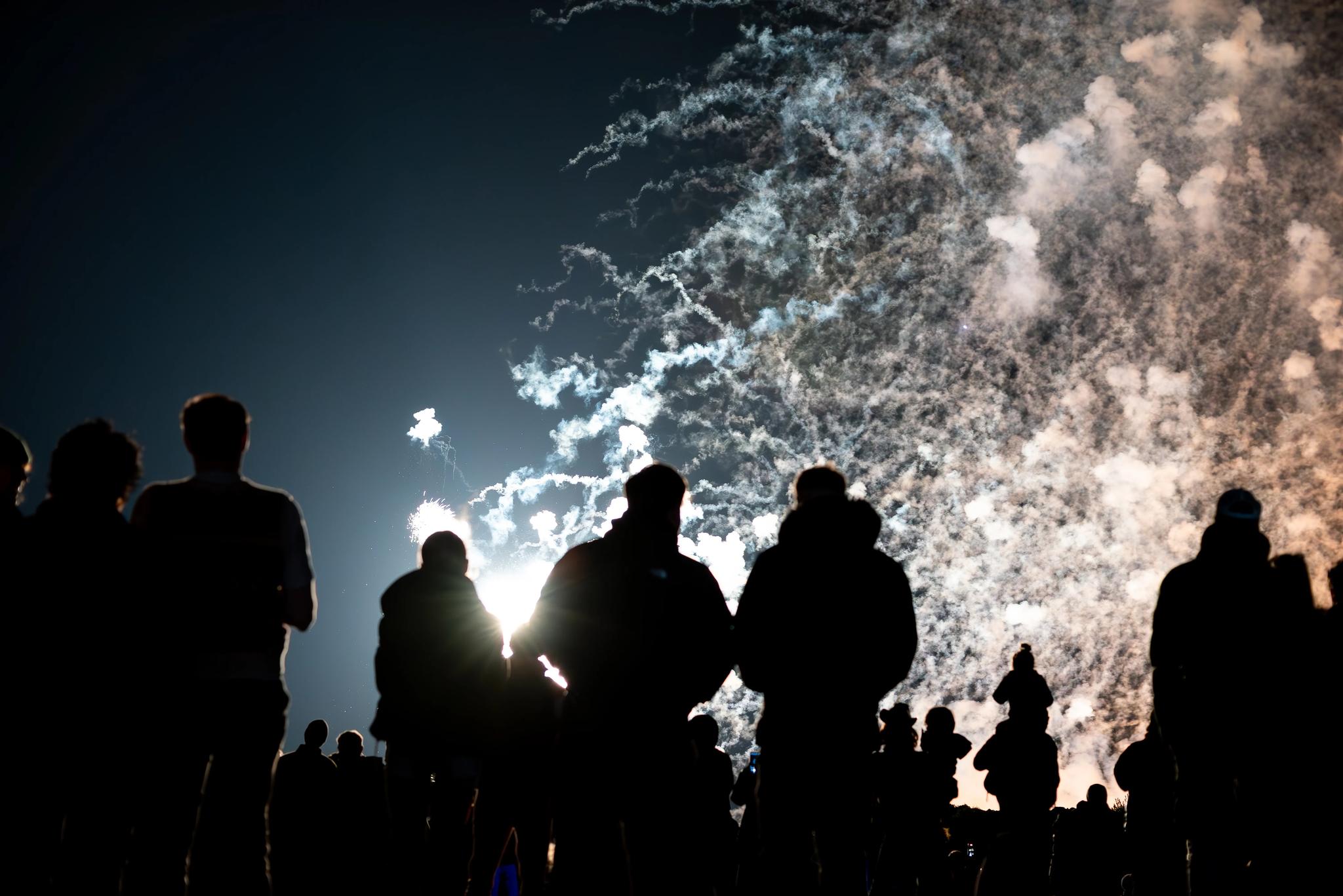
Every year we set fire to the sky. Why?
Fireworks pollute the air and endanger wildlife, raising questions as to whether they can still be considered a sustainable form of entertainment.
Clouds congregate. Wind rages. Rain pours. That is, at least for most days in the British calendar. But on November 5th, fire briefly becomes the country’s dominant element.
Stacks of wood are piled high as people gather around the pyre before setting it alight. Jet-black smokestacks form billowing towers, briefly omitting the pyrotechnics of the fireworks that stud the sky. Two months later, the heavens are set alight again – this time by fireworks on New Year’s Eve. Friends and families band together for organised fireworks displays or worse, set off their own. For most people, both traditions are happy ones. Not for the environment.
Every year, both bonfire night and New Year’s Eve celebrations contribute to alarming levels of air pollution across the UK. According to data released by Defra (Department for Environment & Rural Affairs), on both days and subsequent ones, air pollution is ranked anywhere from moderate – a level four to six on the air quality index of one to 10, advising those with lung issues and the elderly to reduce activity – to very high; a level 10, meaning anyone with breathing problems should avoid going outside. In Swansea, Wales, where the air quality is already moderately polluted, air pollution reached a level 9 on New Year’s Eve in 2021. Provisional data states that in 2022, it was level 10.
Air pollution is not a new issue but it is a pressing one. Wood burners have more recently come under fire for their role in worsening pollution, while one UK study has linked air pollution to a rise in mental illnesses. And pollutants in the air are even more lethal for children. While firework displays are short-term, the speed at which they pollute is damning. According to a study conducted by Newcastle University in 2018, bonfire night averaged 80 micrograms/m3 of PM2.5 in four hours across the local Tyneside area. Compare that to the UK average of 25 micrograms/m3 – or worse, the World Health Organisation’s recommended amount of 10 micrograms/m3.
PM2.5 or particulate matter is the primary pollutant released by fireworks into the air. These are tiny invisible particles which when entered into the bloodstream can cause long-term health issues such as asthma, lung cancer, strokes and coronary heart disease. Professor Phil James of Newcastle University, who conducted the study of fireworks pollution at Newcastle University, says there is cause for concern regarding fireworks.
“While we can’t attribute all the pollution on bonfire night and new year’s eve to fireworks, the numbers are pretty irrefutable,” explains Dr James. “When we did our study, climatic conditions were optimal for fireworks to pollute the air, meaning there was low cloud cover and little wind. A bit like setting off fireworks indoors.”
Some years are worse than others. 2020 was a particularly polluting year on bonfire night with much of the UK reaching moderate to high levels of pollution that lingered for four days across the entire country. And while not all of this pollution can be attributed to fireworks – bonfires and mass irregular car journeys are major pollutants as well – the years of data make for a noticeable pattern. The link between fireworks and air pollution, as a result, is becoming increasingly well-documented, but less is known about the effects on wildlife. And it’s here where the argument for the continued use of fireworks hits a roadblock.
Dr Claudia Wascher, a scientist and zoologist who published one of the first major studies of fireworks’ impact on animals – focusing on how the heart rate of geese rose 96 per cent as a result of pyrotechnic displays – said that while more research needs to be done, fireworks are likely to have more impact on wildlife than we realise.
“Anecdotally, we’ve known animals and geese specifically have a panic response to fireworks,” says Dr Wascher. “They take flight when they wouldn’t otherwise. This isn’t normal and they risk injury and getting lost.”
This disruption can be incredibly damaging for the animals. “There are individual differences and exceptions in every species but fireworks destabilise animals overnight,” she explains. “Fireworks throw them off migratory paths, making finding food a case of life and death.”
Some individuals argue that fireworks still pose a relatively small risk compared to other more regular pollutants like cars and wood-burning stoves. That at least is the reasoning given by Fraser Stevenson, Vice Chairman of the British Fireworks Association. “There was a recent report commissioned in Germany – which has very similar firework products to the UK – that found that fireworks account for 0.7% of the particulate matter released annually,” he explains. “So removing them from the equation would at best reduce impact by 0.7 per cent. Logic would suggest that there are bigger targets to aim for, well before considering fireworks.”
Barbeques, for example, are arguably more deserving of restrictions, says Mr Stevenson. “The same report shows that a typical barbecue for 8 people produces the same amount of CO2 as 564 fireworks or over 14,000 rockets.”
There are other reasons in defence of fireworks too. Dr James says that while there is evidence of fireworks polluting, we need to consider their social benefits and costs of them. “There is a social amenity value of people getting together watching the fireworks. Of course, there are trade-offs but in our research, we’re looking to understand if we can quantify those trade-offs. Are there hidden values to fireworks that outweigh banning them?”
What does the future of the sky look like? Dr Wascher says light shows and organised displays could prove to be a solution, but even that isn’t perfect. And as to whether fireworks can outlast a growing body of evidence against them, this is becoming more of an ethical decision than anything: between humans and the environment, whose well-being ultimately comes first?
“We need to ask ourselves whether human feelings and desire should be prioritised over the health of our wildlife,” says Dr Wascher. “Human beings tend to stick with the things we have done throughout history. But as a scientist I’d ask – can’t we find a better way to do things? Fireworks won’t be banned overnight, but we can look to be better to the world around us.”
Post a comment